
 Español










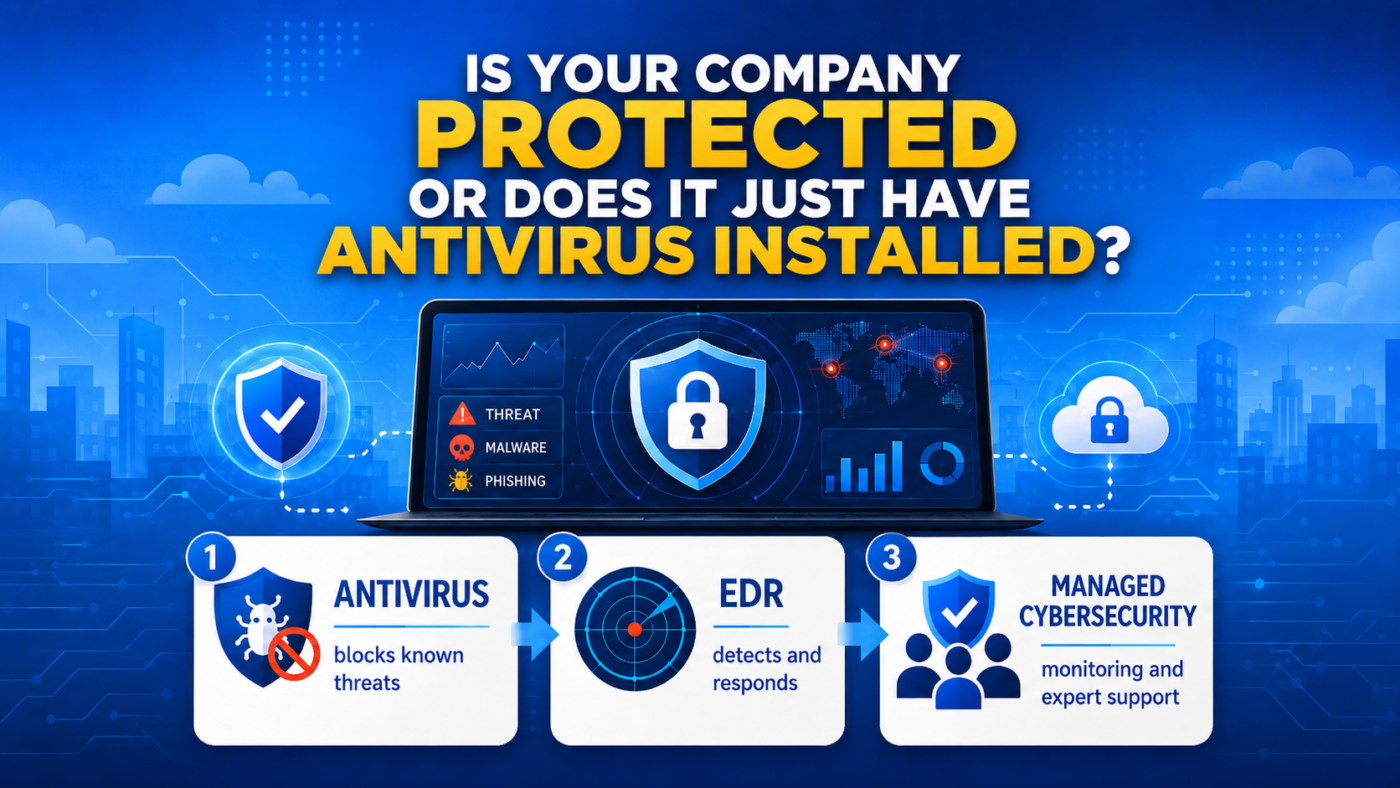
For years, many companies have believed that having antivirus software installed was enough to protect their systems, files, and operations. However, today’s cybersecurity landscape has changed. Attacks are now more sophisticated, faster, and often don’t rely solely on infected files.
The real risk lies in believing that a single tool can stop all threats.
Enterprise antivirus is still important, but it should no longer be seen as the only line of defense. To reduce risks, companies need a more comprehensive strategy that combines prevention, detection, response, and continuous monitoring.
Traditional Antivirus: The First Layer of Defense
Traditional antivirus is designed to detect and block known threats such as viruses, malware, or suspicious files. Its main function is to prevent infections on computers and servers.
This layer is still useful, especially for protecting basic endpoints. However, it has a limitation: many modern attacks do not behave like traditional threats. For example, an attacker may use stolen credentials, legitimate system tools, or social engineering techniques to access a network without triggering an immediate alert. In these cases, antivirus alone may not be enough.
According to CISA, organizations should adopt best practices for prevention and response to reduce the impact of incidents such as ransomware, rather than relying solely on a single solution [1].
EDR: Real-Time Detection and Response
Unlike traditional antivirus, an EDR solution does not only look for malicious files. It also analyzes behavior, suspicious activity, and signs of attacks within systems and servers.
This allows organizations to detect threats that are already inside the environment, investigate what happened, and respond before the incident escalates. For example, if a device starts running abnormal processes, connecting to suspicious destinations, or modifying files in bulk, EDR can generate alerts, isolate the device, and help contain the attack.
In other words: antivirus helps prevent; EDR helps you see, understand, and respond.
Managed Cybersecurity: Protection with Experts Behind It
The next level is managed cybersecurity.
Many companies have security tools, but they don’t always have the time, staff, or expertise to review alerts, interpret incidents, and make quick decisions.
This is where managed services come in: specialists monitor, investigate, and respond to potential threats. This ensures that the company does not rely solely on installed software, but on an operational strategy.
So, what does your company need?
The answer is not to choose between antivirus, EDR, or managed cybersecurity. The ideal approach is to build layered protection.
A better-protected company should have:
- Enterprise antivirus to block known threats.
- EDR to detect suspicious behavior.
- Patch management to close vulnerabilities.
- Secure access and password policies.
- Continuous alert monitoring.
- Incident response capabilities.
- Training against phishing and human error.
Microsoft has pointed out that modern attacks combine tactics such as phishing, identity theft, impersonation, and access exploitation, which means defense must go beyond a single tool [4].
At Nubetia, we don’t just help your company acquire cybersecurity licenses. We also support configuration, monitoring, management, and response so that these tools truly deliver value.
Having antivirus is a good start. But having visibility, response capabilities, and experts supporting your operation can make the difference between a controlled alert and a critical incident.
If you want to understand your company’s current level of protection, Nubetia can help you assess it. You can schedule a consultation call here.
References:
Cybersecurity and Infrastructure Security Agency. (2023). StopRansomware guide. U.S. Department of Homeland Security. https://www.cisa.gov/stopransomware/ransomware-guide
Microsoft. (2025). Microsoft digital defense report 2025. https://www.microsoft.com/en-us/corporate-responsibility/cybersecurity/microsoft-digital-defense-report-2025/
