
 Español



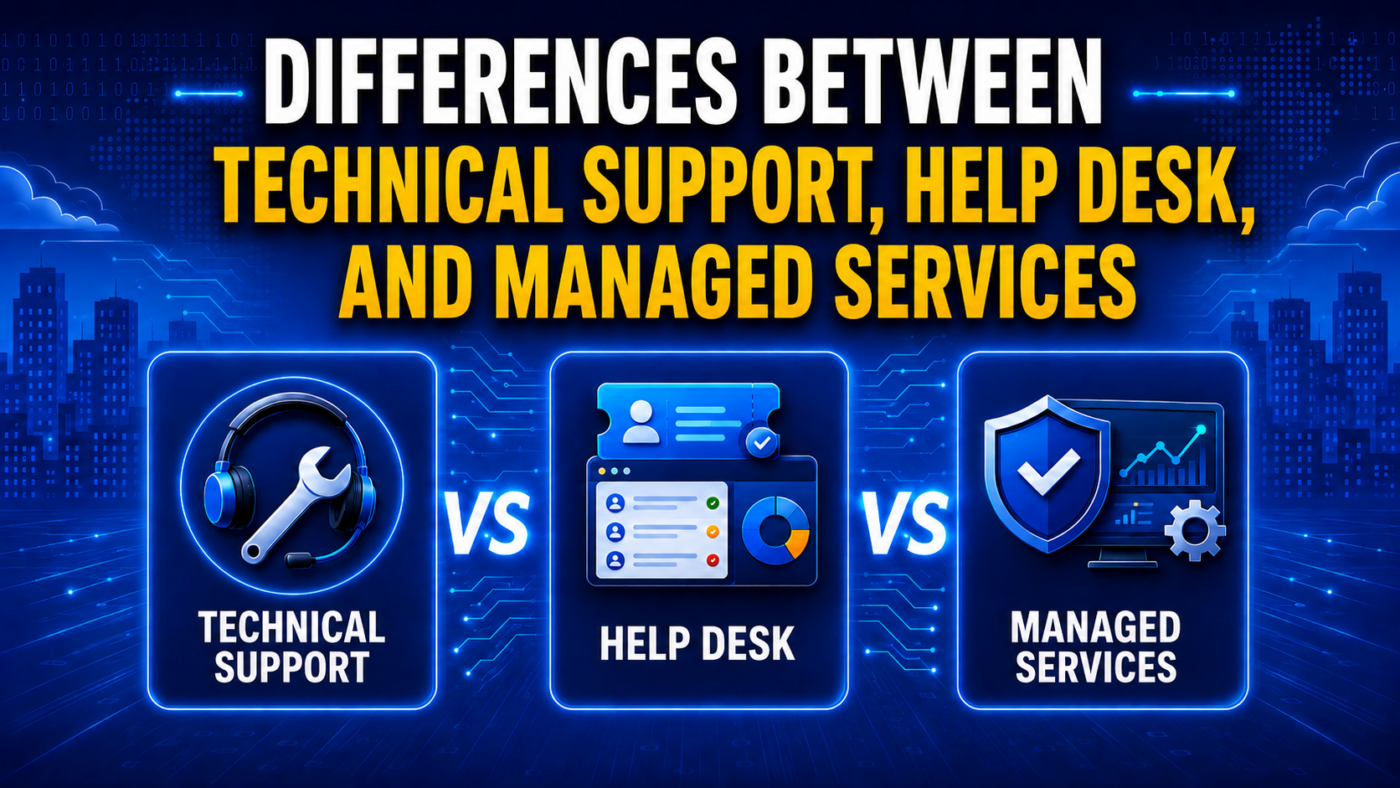
Not all IT support operates the same way. For many companies, “having support” means calling someone when a computer fails, the internet goes down, or a system stops responding. However, there are different levels of IT service delivery.
Understanding the differences between technical support, help desk, and managed IT services helps organizations choose a model that better fits their operations, budget, and risk profile.
What Is Technical Support?
Technical support is typically a reactive model. In other words, it is activated once a problem already exists. For example, an employee cannot access their email, a printer is not working, a laptop has issues, or a system is generating errors. In these cases, the IT team responds to resolve the incident.
This model can be useful for specific, occasional needs. However, when a company relies too heavily on corrective support, issues are often addressed only after they have already impacted operations.
The risk is clear: without monitoring, reporting, or preventive measures, the organization may face the same incidents repeatedly.
What Is a Help Desk?
An SLA, or Service Level Agreement, defines the expected response times and conditions for service delivery. Handling a password reset request is not the same as responding to a server outage. An SLA allows organizations to establish priorities based on impact and urgency.
Within a help desk, SLAs help measure service performance and ensure that requests are handled in an organized and timely manner.
Value-added managed IT services
Managed IT services go beyond handling tickets. Their approach is preventive and continuous. In this model, a specialized provider can monitor endpoints, servers, networks, backups, licenses, security, and performance. The goal is to detect risks before they become critical failures.
Managed services typically include monitoring, automation, maintenance, reporting, tool administration, patch management, and continuous improvement recommendations.
Managed service providers can help small and medium-sized businesses reduce vulnerabilities through controls, standards, and cybersecurity best practices.
All three models can be useful, but they do not address the same needs.
A small business with few devices may start with technical support. A company with multiple users and frequent requests may require a help desk. An organization that depends on its systems to sell, operate, or serve customers should consider managed services.
What Model Does Your Company Need?
To choose the right model, consider these questions:
- Do your IT issues occur frequently?
- Do you know how long it takes your team to resolve incidents?
- Do you have monitoring in place for servers, networks, or backups?
- Are there monthly performance reports?
- Are your tools properly updated and managed?
- Can your business continue operating if a critical system fails?
If most of your answers are “no,” your organization likely needs to move from a reactive approach to a more preventive model.
At Nubetia, we help organizations identify the support model they need, implement the right tools, and strengthen their IT operations through monitoring, automation, reporting, and prevention.
Schedule a review to determine which support model your company needs. You can schedule a consultation call here.
References:
Information Technology Infrastructure Library. (s. f.). Welcome to ITIL. https://www.itil.com/
National Institute of Standards and Technology. (2019). Improving cybersecurity of managed service providers. U.S. Department of Commerce. https://csrc.nist.gov/pubs/pd/2019/10/08/improving-cybersecurity-of-managed-service-provide/ipd
Cybersecurity and Infrastructure Security Agency. (s. f.). Small and medium businesses. U.S. Department of Homeland Security. https://www.cisa.gov/audiences/small-and-medium-businesses
