
 Español








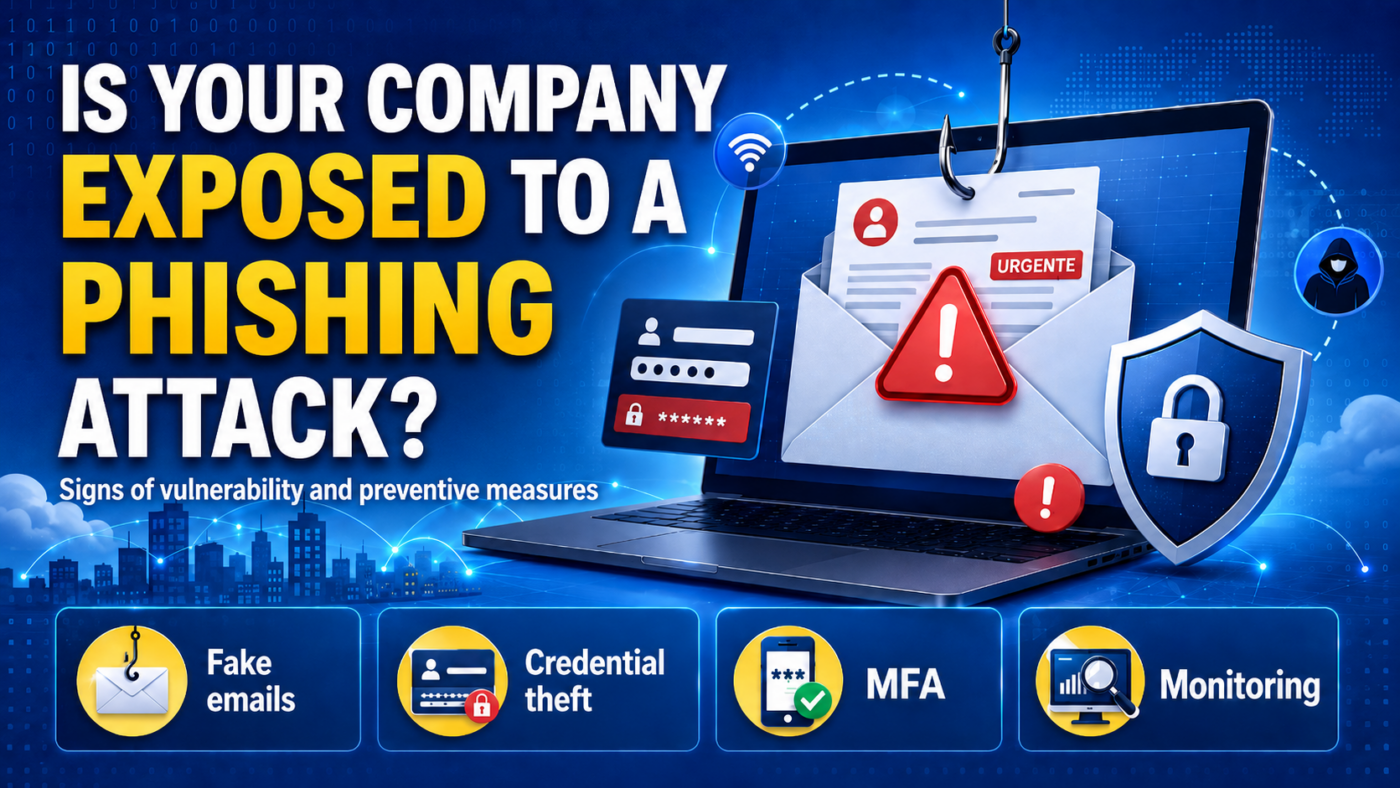
A phishing attack can start with a single email. It may look like an invoice, a bank notification, a shipping message, or an urgent request from a supplier. But behind it, there could be an attempt to steal credentials, impersonate identities, or access sensitive information.
Phishing is one of the most common threats for companies of all sizes. The reason is simple: it doesn’t only target technology, it also takes advantage of human error, lack of training, and weak internal processes.
According to CISA, training employees to recognize and report phishing attempts is a key measure to protect businesses.
What is a Phishing Attack?
A phishing attack occurs when a cybercriminal tries to trick someone into providing confidential information. This could be a password, an access code, banking details, or company data.
The attacker usually impersonates a brand, supplier, bank, executive, or well-known platform. The goal is to get the user to click a link, download a file, or share information without verifying the source.
The FTC warns that phishing emails targeting small businesses often mimic messages employees receive in their daily operations.
Signs your company may be exposed:
1. Employees Cannot Identify Suspicious Emails
If your team does not recognize signs such as strange links, fake senders, domain errors, or urgent messages, the risk increases.
Training should not be occasional. It should help employees pause, verify, and report before clicking.
2. No Multi-Factor Authentication in use
Every SME should maintain regular backups of critical information. This includes databases, operational files, administrative documents, and key systems. However, it is not enough to create backups. It is also necessary to test that they can be restored correctly.
Backups are essential for recovery from failures, human errors, or attacks such as ransomware.
3. No Email Filtering or Advanced Protection
If all emails go directly to the inbox without analysis, the company relies too heavily on user judgment. Email filters help detect malicious links, suspicious attachments, domain spoofing, and fraudulent messages.
4. No Access Monitoring
A phishing attack is not always detected immediately. Sometimes, attackers steal credentials and log in days later. That’s why it’s important to monitor unusual access, unknown locations, multiple failed attempts, and suspicious changes in critical accounts.
5. Shared Passwords or Accounts
When multiple people use the same account, it becomes harder to track who did what. Additionally, if a password is compromised, the impact can be greater.
Each user should have their own access and permissions based on their role.
6. No Clear Process to Report Suspicious Activity
If an employee receives a suspicious email, they should know who to report it to. They should also feel safe reporting it without fear of blame. Speed can prevent a phishing attempt from becoming a larger incident.
How to Reduce Phishing Risk
To better protect your company, start with these actions:
- Train your team to identify fake emails.
- Enable MFA on email and critical systems.
- Use email filtering and anti-spoofing protection.
- Monitor access and suspicious activity.
- Review user permissions.
- Create an internal process to report phishing attempts.
- Run simulations to measure your level of exposure.
Cybersecurity does not depend on a single tool. It depends on combining technology, processes, and prepared people.
At Nubetia, we help businesses assess their current security posture, implement appropriate solutions, and strengthen their technology operations.
If you want to understand your company’s current level of protection, Nubetia can help you assess it. You can schedule a consultation call here.
References:
Cybersecurity and Infrastructure Security Agency. (s. f.). Teach employees to avoid phishing. U.S. Department of Homeland Security. https://www.cisa.gov/audiences/small-and-medium-businesses/secure-your-business/teach-employees-avoid-phishing
Federal Trade Commission. (2018, November 30). Cybersecurity for small business: Phishing. https://www.ftc.gov/business-guidance/blog/2018/11/cybersecurity-small-business-phishing
National Institute of Standards and Technology. (2022, January 10). Multi-factor authentication. https://www.nist.gov/itl/smallbusinesscyber/guidance-topic/multi-factor-authentication
